Showing posts with label wilderness survival. Show all posts

Monday, 27 May 2013

Wild Hut 20

Location:
Avon Water, Hamilton


A good friend Gordon Anderson was keen to experience another wild hut building challenge. We parked the car at Chatelherault Country Park just outside Gordon’s home town of Hamilton and followed a woodland trail which shadowed the River Avon far below. These ancient woodlands were one of the great assets of the royal hunting estate of Cadzow, which came into the possession of the progenitors of the Hamilton family in the early 14th century.
 

We passed some huge gnarled trees which looked like a herd of calcified elephants, and is thought to be the oldest living oak woodland in Scotland. Dendrochronology (scientific tree-ring analysis) has ascribed them to the 1460s (550 years old-ish).


Soon after, we passed another interesting feature - a carved old log which read; “As soon as you take one thing by itself you find it hitched to everything else in the universe”. It was intriguing to find some John Muir paraphrasing deep in these ancient woods. Muir expanded on this point with another less elegant but more descriptive quote; "When we try to pick out anything by itself we find that it is bound fast by a thousand invisible cords that cannot be broken, to everything in the universe.” I’m fairly sure we humans will hang ourselves with these cords long before we understand their critical value.


The Build:
We came to a sharp bend as the path steered away from some steep falling ground. As we left the path in search of a suitable build site, I noticed the cool forest had a thick carpet of wild garlic and tumbled trees. Gordon suggested that our hut concept echoed the form of an old ‘look-out hide’ which was perfectly fitting for this royal hunting estate location. This poetic observation helped to connect the project with the rich history of the woods.

 
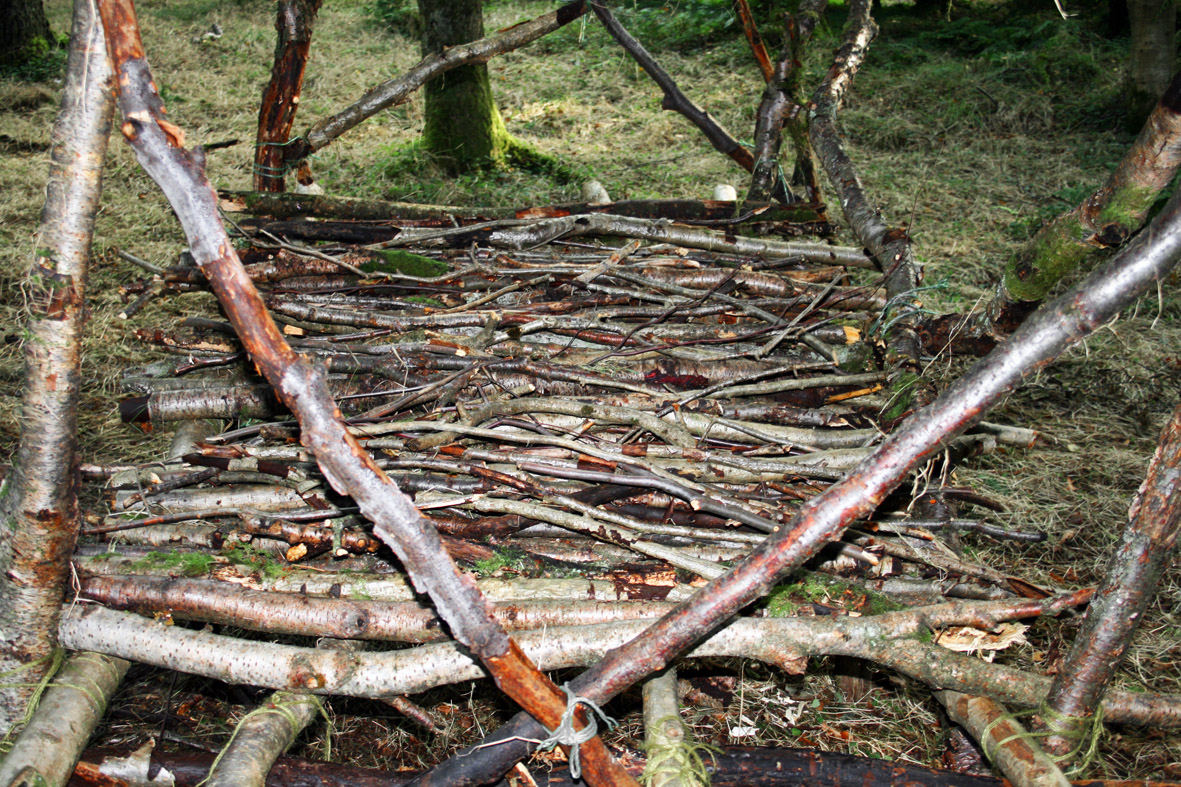
As the area is predominantly characterised by a dramatic steep-sided gorge, I thought it would also be fitting to create a structure that dove-tailed with the topography. We decided to create a sleeping platform which could be suspended above this steep gorge by projecting out from the hillside. We scooped up a plentiful supply of fallen deadwood and bound the primary structure with biodegradable garden twine.
 
 
Gordon found working with the twine a minor struggle so I got to work on 4 large sandwich panels as he arranged the sleeping platform. The panels were heavy and difficult to place at high level. As I climbed on the structure in order to arrange a roofing panel I smashed through one half of the sleeping platform. After I patched it up Gordon suggested that at least he now knew which side he was sleeping on!
 
 
We had a deadline for 6:30pm as the Champions League football final was being played that evening and we had ambitions to watch it. We completed the last roofing panel together and hauled it onto the frame. Other than some patching-up, the build was complete by 6:45pm and we headed back along the twisting path for a mixed Kebab and a night of European football action.
 
 
Roughing it:
At around 10pm we hopped back into the car with a football sized kebab wedged in our stomachs, remarking on how lucky it was that the hut was well ventilated.

 
We parked the car in a nearby housing estate and walked swiftly past groups of arguing youths. Our packs were laden with camping gear and we tried not to draw any unwanted attention to ourselves. We crossed the formal lawn at Chatelherault Estate and noticed a fox silently stalking some rabbits in the darkness.
 
 
Back at the hut-site we spent an extra hour building a small sandwich panel each which completed the roof covering. A large lemon-yellow moon shone through the dark woods as we climbed precariously onto the elevated platform and wriggled into our sleeping bags. The sound of the river rushing far below was often broken by the sound of distant cars screeching through the nearby country lanes. Similarly, Gordon’s snoring was often interrupted by the sound of screeching foxes in the fields beyond the forest edge. I’m not altogether sure which was better.
 
 
We woke to a typical Scottish breakfast of mince pie, washed down with some luminous orange Irn-Bru (which incidentally has a warning on the can suggesting it may cause ‘behavioural changes in children’?!) It was indeed the breakfast of champions.


After a loud cracking noise I turned to see Gordon snapping through his bed slats. He pulled his arse back through the branches and re-distributed his weight more evenly.  
It turns out it is very difficult to control your laughter when someone is dangling precariously in their sleeping bag over a steep embankment.

Thursday, 17 January 2013

Wild Hut 14

Location:
Carbeth Loch, by Strathblane.


3-Man Shelter:
I was very fortunate to be contacted by the producer of BBC Scotland’s radio show ‘Out of Doors’Chris Sleight. He seemed keen to feature the 100 Wild Huts project on his show. People have often said to me that I ‘have a face for radio’ so this seemed like a great opportunity. I also somehow managed to persuade the producer to help actually build a wild hut and sleep rough for one night. He agreed to come along, although I’m not sure he initially grasped the lengthy timeframes and workloads involved.

I was keen to explore with him the craft, the architectural quality and the experiential impact of creating a shelter and sleeping rough outdoors. I had a growing concern though that I would sound, to a national audience, like a bumbling idiot or indeed just an eccentric fool! It’s probably a fair reflection though as eccentricity and I have been happy bed-fellows for some time.


We pulled the cars over in a lay-by close to Carbeth Loch on the West Highland Way. Carbeth is around 11 miles north of Glasgow and fairly close to the orbital towns of Milngavie and Strathblane.  Ironically, Carbeth has a history of hutting dating back to the1920’s. Around 140 self-built retreats are scattered around the loch and surrounding area which has taken on the appearance of a caravan holiday park built by beavers.

The community of huts were established as a retreat from the stifling effects of Glasgow and Clydebank’s heavy industrial heritage. This is a notion I’m sympathetic to. They recently completed a community land buy-out: “The hutters would like to extend an invitation for people to come along and explore Carbeth.  In the next 2 years the hutters will need lots of support, funding, media attention and solidarity.  There are also opportunities to buy huts and sites and join the hutting movement into the future.”


I also invited a university friend Richard Patterson to help with the build as Chris would be occupied with his BBC recording duties and to our delight he even agreed to cook us dinner! My friend Richard has a company which specialises in ‘Virtual Tours’ (www.360pix.co.uk) and was interested in shooting some 360° photographs of the hut interior on it’s completion. The build was not only being recorded ‘acoustically’ for radio purposes, but also recorded ‘panoramically’ for visual purposes (I also offered to complete the full set and record the smell and taste of everything!...they weren't impressed).

  
We gathered our bundles of gear and ascended a steep track which led up into some mixed woodland. The elevated spot we picked for the build was fairly close to a crop of dried bracken and a tangled spaghetti of fallen branches. There seemed to be a natural ledge cut into the hillside, with a steep forested slope ascending to the east and dropping sharply away to the west. The temperature was threatening to plummet to -4 and we knew we had to keep busy in order to stay warm.
  

The Build:
The forest seemed to be fairly unmanaged and the volume of storm-felled timber was a pleasure. As I waffled mindlessly for the radio production, Richard flew into action and gathered most of the timber required for the entire build in less than an hour. As is the normal routine now, we bundled the timbers into ‘structural’ and ‘non structural’ piles. After some initial recording Chris and I got to work and lashed together a series of simple A-frame sections. We then laid out a number of long timbers - strategising about the sleeping platform and roof construction.

On completion of the first platform, we positioned it in a clearing between the trees. Unfortunately the sagging structure jiggled sideways like wobbly jelly. Keeping the components upright and straight is a bit like pushing custard uphill. Finally after a few more turns of the garden twine - this first part of the structure was now free standing(ish). Richard completed the 2nd mirror image component and we aligned them in position ready to bridge between with the third sleeping platform. After a few more timbers were added – the whole structure became rigid. As more wood was overlaid the joints tightened with laminating rigidity.

Due to limited tools Chris found all the timber for the bed platforms as Richard and I bailed the bracken tiles for the roofing. We worked efficiently as a team, pausing from time to time to partake in interviews. The bracken was icy and interwoven with shards of frozen snow which made it awkward to bail. After some outstanding sausages for dinner (thanks Chris) and many hours of tiling bracken the structure was complete and ready for road testing.

Richard had started a campfire inside the hut which had a great warming effect although also threatened to choke everyone in their sleep and sizzle holes through their sleeping bags. Being the most intelligant of the 3 – I picked the bunk directly in the line of wind-driven smoke and ash. It was indeed the warmest bunk but the smoke inhalation took the edge off my enjoyment.


Roughing it:
The fire subsided as we lay down on the beds of rolling logs at around 1am (-4 degrees). We recorded a short interview before bed and were all in agreement that this was quite a pleasing hut-structure and were satisfied with the outcome and efficiency of the build. An owl was hooting from a nearby tree, which was soon replaced with synchronised snoring from 2 nearby bunks.  

An hour or two later I was awoken with the padding footsteps of a heavy animal just by the hut. It seemed to approach the hut then amble off through the undergrowth. The next morning Chris had also heard something snuffling around our bags outside. He thought it was perhaps a fox or deer, I wondered if it might have been a badger as it sounded heavy?

(Now…I mentioned the possibility of it being a badger on the radio interview and then frantically searched the internet on my return home incase badgers hibernated all winter…I didn’t want to sound both stupid and eccentric all in one 6 min radio programme.)

An orange haze glowed on the horizon as the sun glanced through the dark forest. We stirred in our bunks early and recorded a final section for the radio show where I blurted a few incoherent words whilst trying to sound awake. We said our goodbyes to Chris who had a busy schedule including the school run that morning and a full day's work. Richard used the welcome dawn light to take some 360 panoramic photographs and we packed our gear away.

I mentioned that it’s always astounding how many people show an interest in the simple act of building a make-shift roof and bed in a wild place. It must be an integral part of being human, a natural instinct that can only be engaged with through the act of exploring and building. Richard suggested that the radio chap had gone now and that I could stop talking rubbish!


View 360 Tours of this hut courtesy of 360PIX

Sunday, 23 September 2012

Wild Hut 8

Location:
Mavis Valley, Wilderness Plantation, Bishopbriggs

Just north of Glasgow is a strange rectangular woodland which is depicted on 19th century maps as a ‘wilderness plantation’. The woods are interrupted by an ugly recycling centre and the Roman Antonine Wall passes just yards from its north boundary. Just to the south of the woods across a field, is the lost village of Mavis Valley which was built in 1855. Nothing remains of the village today (other than some brick footings) but it was once a thriving coal mining community.


I had managed to convince my girlfriend to come and explore these woods with the possibility of building and sleeping in a hut. She suggested she was happy to go as long as it was not a regular occurrence. She had already been out ‘hutting’ the previous weekend so I was skating on thin ice. We turned sharply off-road along the old access track to Mavis Valley and came to halt in the sticky mud. I got out and pushed and we soon found a suitable place to park. The dense forest had a series of man-made ditches which ran their full length. This area had become a local dumping ground and we clambered past old prams, gas bottles and tyres to the forest beyond.


The Build:
Once we entered the woods it was clear that few people used them for recreation purposes. There was no sign of any well used footpaths or even any evolved muddy trails. We did find the odd beer can and a couple of broken tents although these looked more like teenage parties rather than the drug-dens of inner-city Glasgow. We wandered quietly across the dense wet carpet of moss and ferns, exploring this magical pristine forest.

We managed to find lots of large structural branches fairly quickly and got to work constructing the hut frame. The basic concept is much like a 4-poster bed (only the best for my girlfriend!) with a lightweight canopy above for shower protection.


I decided that the roof could be built like modular panels and lifted into place. We built 2 simple ladder-frames and tiled them with foliage. This was fairly time consuming but created light-weight, sturdy panels which were easy to lift. The structure was shower-proof in around 3 hours. I also completed the double bed by laying out lots of horizontal branches and twigs which created a springy platform.  


I decided to road test the structure so jauntily hopped-on and heard an almighty CRACK as the first structural timber split. I asked Kirsty to also apply her weight…and we soon found ourselves snapping the entire sleeping platform. Like many household beds there are often small ‘central-legs’ underneath which help support the mid point. I set about finding better timber and hammering support posts underneath around halfway. The bed was now fit for Pavarotti himself and we rolled out the sleeping bags and made a small fire.


Roughing it:
The fire kept the midges at bay which were a mild irritation the whole evening. Kirsty had earlier mentioned that she had been bitten by a mosquito like creature. After stupidly explaining to her that ‘we don’t really get mosquitoes in Scotland – I soon noticed one sinking its needle-like face into my arm. This is the first time I had ever seen a mosquito in Scotland let alone jousting with a family of them in the forest. I later found I had large blister-like bites all over, along with the smaller midge bites and a variety of sheep ticks clinging to exposed areas of skin. Of the 3 I still think midges are the most irritating although ticks are itchy after the event much like mosquitoes. The mosquitoes though do have the most irritating bite which can be blister-like for days after. I guess this is the effects of climate-change and something us Scots will have to get used to.


Our sleep was often broken by noisy trucks screeching past the woods or the occasional firework from a nearby housing scheme. I had expected to see deer or foxes but the woods remained eerily quiet other than a distant falling branch cracking the silence.


We woke to another cool sunny morning and left as we had arrived via the recycling plant. Kirsty remarked that she didn’t have a single tick or mosquito bite. Enviously, I suggested it’s because bugs only like clean people! She smiled as I looked down at my filthy clothing, and the scent of wet earth.


Sunday, 16 September 2012

Wild Hut 7

Location – Mugdock Woods, North Glasgow.

Group Hut
‘Experience gathering’ defines humankind’s behavioural and evolutionary makeup. Our perception is the process by which we ingest our experiences in unique ways and store them in the library-vaults of our minds. The sum total of these memories help to define who we are; ‘we are…what we experience!’…maybe.

I decided to take some city kids out into the woods for a spot of ‘experience gathering’…but mainly for grass and timber gathering! My daughter Katie is 6 years old and my girlfriend Kirsty’s niece and nephew (Jamie-Lee & Robert) are both 12. We decided to take them to a vast, deciduous woodland just north of Glasgow to build a shelter big enough for 5 people. I grew up building dens in the woods and feel its something a lot of young kids are missing out on. The woods can be an inspirational and immersive place for a child and can supply real wholesome worthwhile experiences that are hard to shake.


To keep it simple, we planned to build a traditional cone-shaped teepee. We picked up the kids around 10am and headed for Mugdock woods just beyond Milngavie. It was dry and sunny, although forecast for rain through the night. We backtracked along the West Highland Way trail until we found a delightful clearing with a ready supply of broken branches nearby. Kirsty armed the team with some scissors and knives and went off to collect bales of long grass for roofing tiles.


I was collecting wood when a lady suddenly appeared with some yappy dogs. ‘What’s going on here?’ she said in a stern authoritative voice which instantly annoyed me. I asked her why people can’t pick up fallen branches in the woods in today’s society without raising suspicion? I then proceeded to tell her that most of the mess around this area is from dog-poo. She apologised profusely and disappeared down the trail in a blur of furry yaps.

I managed to find around ten 2.5m long fallen branches which I whittled with the axe until tidy and straight. I arranged them in a circular cone-shape (3m diameter) and bound horizontal rails between each tilted upright (like a ring of triangular ladders). The rails would support the roofing tiles and stop them draping inwards (the more ladder-rails you have essentially means that water will run off rather than drain through. It also has a laminating effect and braces the whole structure rigidly).     


I quite fancied a shelter which had a hole in the roof for an internal fire chimney, but heavy rain was forecast so I decided the roof should be closed and the fire located outside near the entrance.
    
It took around 5 hours to gather all the timber and build the main structure. By this time we only had enough grass for around a 5th of the hut’s roof. We stopped for dinner and decided on a change of material. The team’s hands were cut to ribbons collecting the sharp grass and binding them into bales so we decided on softer bracken instead. This was a much quicker process and the whole roof was complete by 9pm.

Kirsty built a smoky fire which duly dispersed the biting midges and we all sat round to toast marshmallows on sticks. I rolled out the sleeping bags (5 deep) and by 10:30pm the kids were suitably knackered and snuggled up in the hut searching for dreamland. (Although we stayed mostly dry - a more substantial porch would have been a welcome addition to keep out driving rain during the night.) The roofing tiles shed the bulk of the rain exceptionally well and it just goes to show what can be achieved with a little time and allot of effort.


Around 7am, a group of walkers appeared outside the hut in matching red wellies (there must have been a sale on), extremely surprised to find that the hut was actually occupied! I slept through the whole event though so would have been completely useless had it been a dangerous situation (I had already checked the internet and most violent crime does happen between Thursday and Sunday, but very rarely in the morning…so I slept soundly!).


Jamie-Lee & Robert

I’m not overly sure what the long term effect of hut building and sleeping rough in the forest would be for the kids. They suffer from an experiential-overload much of the time so I’m not sure if these ‘primitive experiences’ can compete with the likes of Harry Potter, the Nintendo-DS and the X-Factor (although you don’t have to pull blood-sucking ticks out your bum watching x-factor!).

Wilderness Shelter - Mugdock woods